
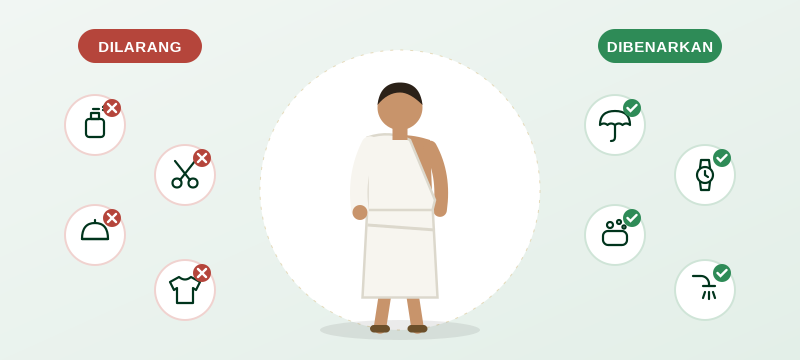
Prohibitions for men only
- Wearing stitched clothing that is shaped around the body, such as shirts, trousers, caps and underwear.
- Covering the head or part of it with anything regarded as a covering, such as a cap, hat or turban.
- Wearing shoes that cover the heel and toes. Open sandals or slippers are allowed.
Prohibitions for women only
- Covering the face with a niqab or face veil.
- Wearing gloves.
Women continue to wear normal clothing that covers the aurah, including the headscarf and socks.
Prohibitions for both men and women
- Applying perfume to the body, clothing, hair or food.
- Cutting, plucking or shaving hair from any part of the body.
- Cutting the nails.
- Oiling the hair of the head or the beard.
- Hunting or killing land game that is lawful to eat, or helping others to hunt it.
- Cutting or uprooting trees and plants in the Haram.
- Getting married, marrying someone off, or acting as wali in a marriage contract.
- Sexual intercourse, and intimacy with desire.
What is allowed during ihram
- Bathing and changing the ihram garments.
- Wearing a watch, glasses, a ring and a belt.
- Using an umbrella or sheltering under a roof or tent.
- Using unscented soap and shampoo.
Dam (penalty)
The type of dam differs depending on which prohibition was broken, and whether it was done deliberately, by forgetting or because of a valid excuse. Consult your mutawwif or an ustaz for the exact penalty.
Frequently asked questions
- Can I use ordinary soap during ihram?
- Yes, as long as the soap is unscented.
- Can women wear socks and a headscarf during ihram?
- Yes. The prohibitions specific to women are only covering the face and wearing gloves.
This guide is a general summary based on the Shafi'i school. For complete rulings, attend an Umrah course and consult your mutawwif or an ustaz. Read also: Umrah Duas · Umrah for Women · Preparation Checklist · Umrah Tips